

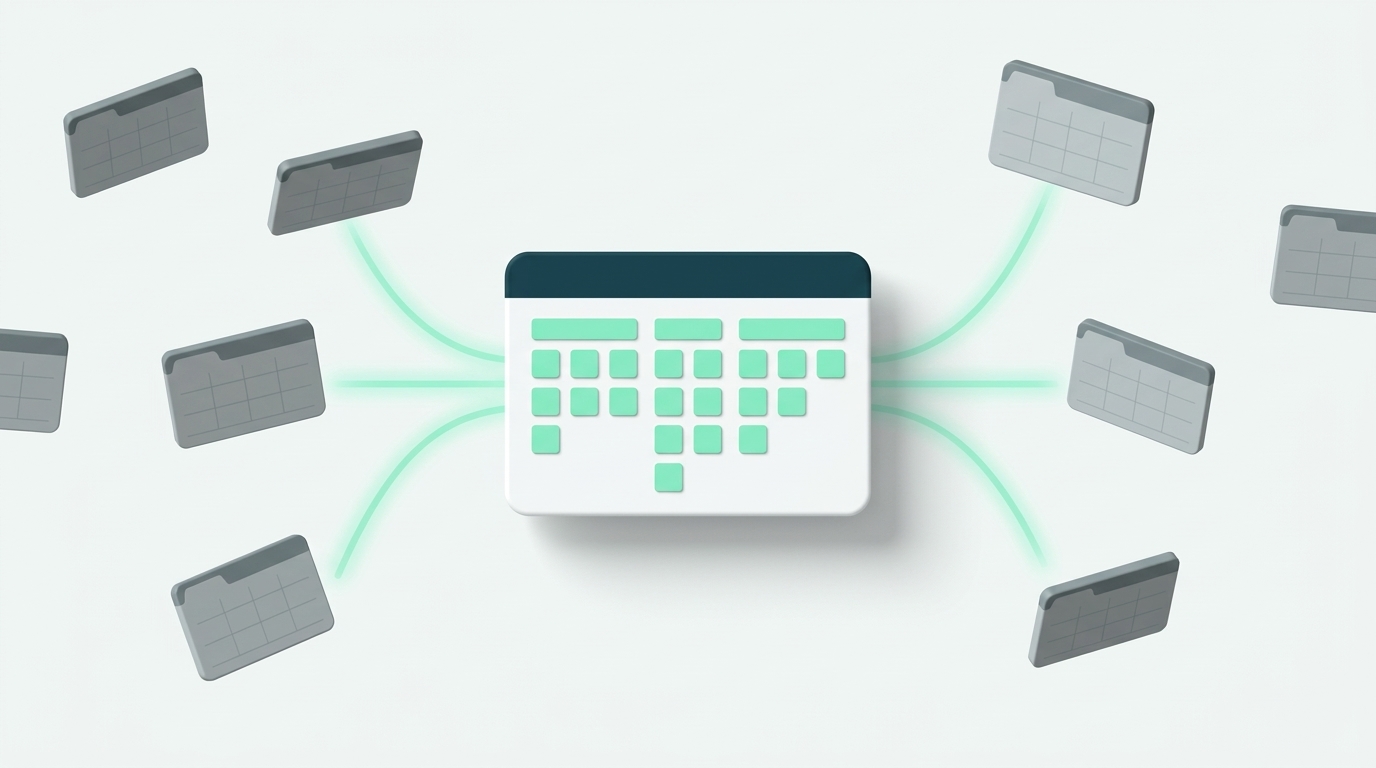
Most small service businesses end up running client work across four or five places at once: a shared inbox, a WhatsApp group, a spreadsheet someone updates when they remember to, and whatever calendar reminders survived the last reorganization. Monday.com gets bought to fix this, and then quietly becomes place number six, another tab nobody trusts enough to stop checking the others. Fixing that doesn't require replacing the platform with something else, it requires treating the first month of setup as a discipline rather than a checklist: what moves over first, how boards get structured before there are ten of them, and what actually gets automated instead of left to memory.
What "Single Source of Truth" Actually Means Before You Touch a Setting
It doesn't mean everything lives in Monday.com. It means that for any question about where a client stands, there is exactly one place the answer lives, and everyone on the team already knows where to look. If two people on the same team can give two different answers to "where are we with this client," the tool hasn't failed, the setup has. That distinction matters, because most of what goes wrong with Monday.com rollouts gets blamed on the platform when the real problem sits one step earlier, in how it was structured before anyone started using it.
The cost of getting this wrong isn't abstract. It shows up as a status meeting that exists purely to reconcile three different versions of the same project, as a client update that goes out twice with two different timelines because two people each thought they owned the answer, and as the quiet habit of double-checking Monday.com against the old spreadsheet anyway, which means the migration never actually happened, it just added a step.
The Migration Mistake Almost Every Business Makes
The most common first move is also the one most likely to kill adoption: dumping every historical project, every closed deal, and every old note into the platform on day one, before anyone on the team has used it for a single real task. It feels thorough. It also means the first thing every employee sees is a wall of stale information with nothing urgent in it, which is the fastest way to teach a team there's no point opening the new tool at all.
Monday.com's own blog, in its 2026 guide to project management software for small business, recommends the opposite approach in its implementation roadmap: moving active projects, their workflows and their deadlines, is literally what the guide says establishes a new platform as the team's single source of truth. That's the order worth following: active work moves first, and it earns the platform trust by being useful for something people are already doing today.
A realistic sequence looks like this: the first week carries only work with a deadline in the next thirty days, nothing older. Templates and status labels get locked by week three or four, once real use has revealed which fields actually get filled in and which ones everyone skips. Historical archives move over in month two at the earliest, once the team already checks Monday.com by habit rather than being told to.
A Board Structure That Still Makes Sense at Client Twenty
A structure that works cleanly for three clients usually collapses somewhere around client eight, not because Monday.com can't handle the volume, but because the boards were built one at a time, each with slightly different fields and status labels, until nothing rolls up cleanly into a single view anyone can trust.
The fix is deciding the structure once, before board six exists: one board per client or one board per project type, with a portfolio-level view pulling status across all of them. Status labels get defined a single time and reused everywhere, never re-typed by hand on each new board. Free-text status fields are the first thing worth eliminating, because "almost done," "waiting on them," and "should be fine" each mean something different depending on who wrote them. A fixed set of status columns, agreed once, removes that ambiguity entirely.
In one multi-market operation I managed directly, work was spread across two regions with different partners and different reporting needs, with no shared view of what was actually happening in either. The fix wasn't a single complicated dashboard, it was one board per market with identical fields, feeding into one summary view I could scan in five minutes before any check-in call. The value wasn't the software, it was finally having one place where the real status of every active piece of work was visible without asking three people first, and being able to walk into a partner call already knowing the answer instead of promising to follow up.
Getting the Team to Actually Use It Past Week Two
Adoption rarely fails because of the tool. It fails because training happened on a demo board with fake data, and then everyone went back to the inbox the moment real client pressure showed up. Training that sticks runs on live, current work from day one, the actual projects people are handling this week, not a sample project built to look tidy.
It also helps to have one person on the team who becomes the informal point of reference, not because they're an administrator, but because early questions get answered fast instead of quietly pushing someone back to the old spreadsheet out of frustration. Whoever built and maintained that spreadsheet is usually the person most resistant to letting it go, not out of stubbornness, but because it represents real ownership they don't want to lose. Giving that person a visible role in the new setup, rather than quietly retiring their work, tends to do more for adoption than any announcement to the wider team. Beyond that, automation inside Monday.com itself matters more for adoption than any training session: a reminder that nudges someone when a status hasn't moved in a set number of days keeps the board current more reliably than asking people to remember to update it.
What to Automate, What to Leave Alone, and When a Patch Isn't Enough
None of this replaces defining the underlying process before automating any part of it. The same principle covered in why most service-business automations fail applies just as much inside Monday.com as anywhere else. Once the process itself is clear, status-change notifications, deadline reminders, and handoffs between stages are safe, mechanical, and worth automating from the start, since they follow fixed rules and don't require anyone's judgment.
The same goes for a handful of small, specific triggers that tend to save real time once set up: an automatic prompt to attach a file once a stage is marked complete, an internal notification when an approval step sits untouched for more than two days, and a status sync back to a CRM or invoicing tool so nobody re-types the same update in two systems. What should stay manual is anything that depends on reading a relationship. Deciding whether a client needs a phone call rather than an automated nudge is a judgment call, and turning that into a triggered notification usually produces exactly the kind of tone-deaf automation that makes clients feel like a number instead of a relationship.
A few warning signs are worth naming directly, because by the time they show up, another quick fix usually isn't the answer. If the same status means something different depending on which board it's read from, if new boards keep getting copied from whichever old one is closest instead of from an agreed template, or if the only person who can explain how a board actually works is out sick this week and nobody else can update it, the setup has drifted past the point where small edits help. At that stage the straightforward move is a structural rebuild rather than another automation stacked on top of a foundation that already doesn't hold, which is exactly the kind of work covered on the fixing what's already slowing you down page.
Key Takeaways
- "Single source of truth" means one place holds the answer, not that every feature gets used from day one.
- Migrate active work first, on a realistic weeks-to-months timeline. Historical data can wait until the habit is already formed.
- Decide your board structure and status labels once, before the number of boards makes it expensive to fix.
- Eliminate free-text status fields early, they're where ambiguity hides.
- Train on real, current work, not a demo project, and automate reminders rather than relying on memory.
- Automate the mechanical handoffs and small recurring triggers. Keep relationship judgment calls in human hands.
- If a board only one person can explain still needs constant patching, that's a rebuild, not a tweak.
Getting this right the first time avoids months of half-adopted boards and duplicate spreadsheets still running in parallel behind them. If your systems have already reached that stage and a rebuild is overdue, that's exactly the kind of work covered on the systems that hold up as you grow page, documentation and structure that don't depend on one person carrying it all in their head.